Knowledge Equals Power in Capturing the SMB Opportunity
Understand today’s small- and medium-sized businesses to retain these relationships as they grow.
For community banks, there is no better time than right now to capitalize on the small- and medium-sized business (SMB) opportunity.
Currently, there are 36 million SMBs in the U.S., representing 99.9% of all businesses. And these companies are growing, with nearly six in ten planning to expand in 2026. This presents community banks with an open invitation to offer financing and other services.
Historically, community banks have over-indexed on serving small businesses, and they currently hold 15.2% of all loans, but 21.6% of small business loans across the industry.
Despite this history, community banks’ share of the SMB lending market has steadily declined since the mid-1990s, when they held roughly a third of all small business loans.
What’s behind this long-term loss of market share?
Consolidation and Competition Put Community Banks on the Back Foot
For one, the community banking market has undergone significant consolidation in recent decades, falling from 8,600 financial institutions in 2000 to fewer than 3,900 in 2026. As banks consolidate, market share naturally migrates to larger organizations.
Secondly, larger regional and national banks are aggressively pursuing the SMB market. Although late to the game, recent technological advances in credit scoring, automated underwriting and digital onboarding are now making it easier and more profitable to serve this market.
And third, online lenders and fintechs have rapidly become a force to be reckoned with, with the share of small businesses that sought financing with an online lender nearly doubling from 17% in 2020 to 29% in 2025.
At a time when small business financial relationships are becoming increasingly fragmented (our latest Banking in Focus survey shows that 86% of SMBs use multiple banking partners, averaging 2.8 financial institutions per business), community banks must refocus their efforts on this critical market.
This starts with an expansion of offerings tailored to growing SMBs, including more robust digital and payment solutions.
Small business banking has long been one of the best and most profitable lines of business for community banks, but to keep pace with the competition and evolving expectations, you must approach it intentionally.
What Are SMBs Looking For from Their Bank?
According to our latest research, more than half (53%) of SMBs surveyed use the same primary financial institution (PFI) for both their personal and business banking.
But this doesn’t mean you should treat your business and retail customers the same. Their needs differ in several important aspects, and community banks must adjust their approach to attract and retain these relationships, especially as they grow.
For micro and small businesses, low or transparent fees are extremely important. As they grow, lower middle market businesses are looking for more sophisticated services. These include access to deep data insights and analytical capabilities, along with fast, easy access to credit.
For businesses that have begun to scale, credit availability and payment access are critical factors for success. One in three SMBs (including 39% of lower middle market businesses) say that credit and payment friction has a high impact on their ability to maintain steady cash flows and invest in growth.
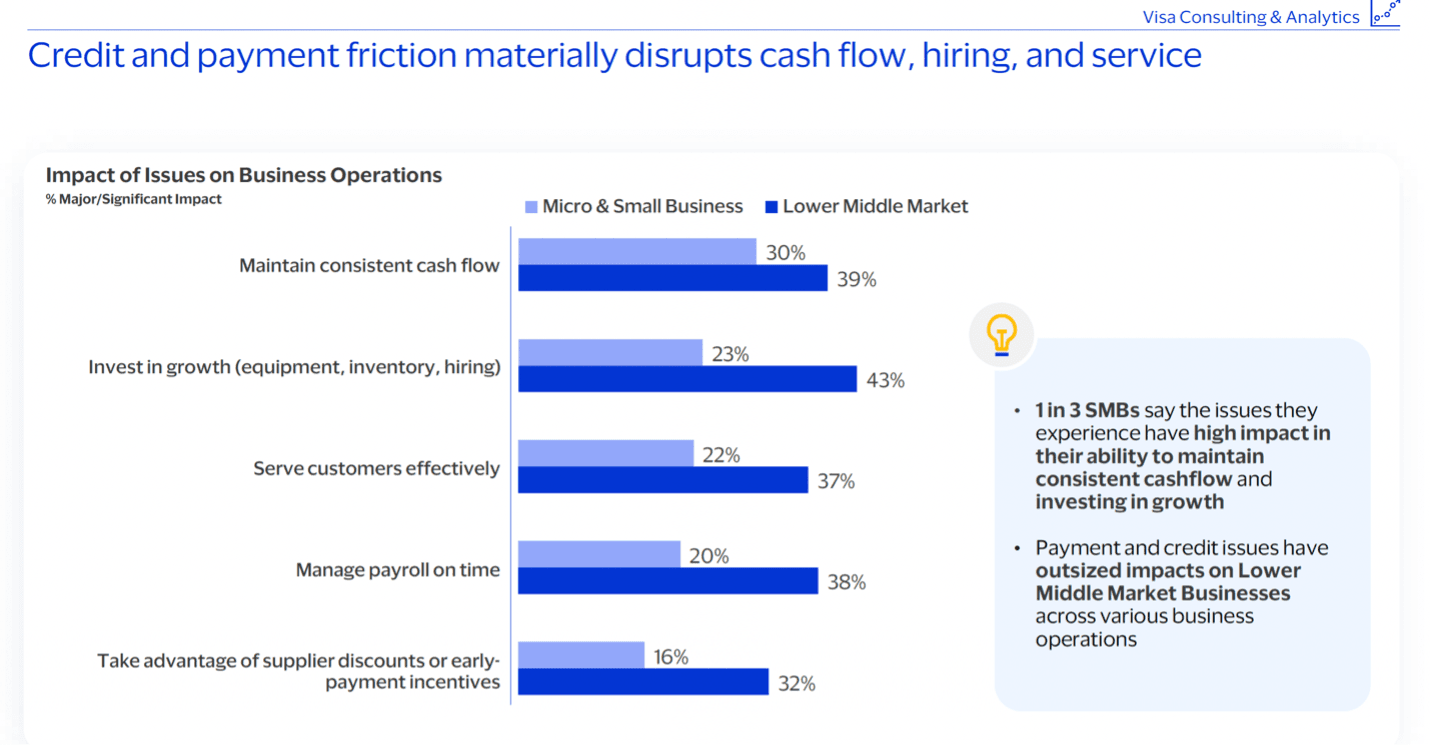
Lower middle market businesses also value security and fraud protection more highly than consumers and smaller businesses, largely because of the outsized impact incidents of cybercrime and fraud can have on their enterprise and customers. Speed of payment settlement is also an important factor for these businesses.
Lead With Payments to Capture Growing SMB Relationships
Community banks are adept at capturing relationships within the micro and small business segment, where the combination of low and transparent fees with outstanding service translates into stronger satisfaction. But to retain SMB relationships as they grow, your bank must be viewed as a partner capable of supporting more complex needs.
The challenge is not to win the relationship. It’s about keeping pace with the business as it evolves.
Collaborating with an industry partner that offers the right digital and payment solutions, fully integrated with your current tech stack, is a great place to start.
Here are four steps toward accomplishing this transition:
- Lead with payments: Payments are the heartbeat of small businesses, and community banks must offer their business customers a comprehensive payments ecosystem to maintain continuous, daily engagement and stay top of mind.
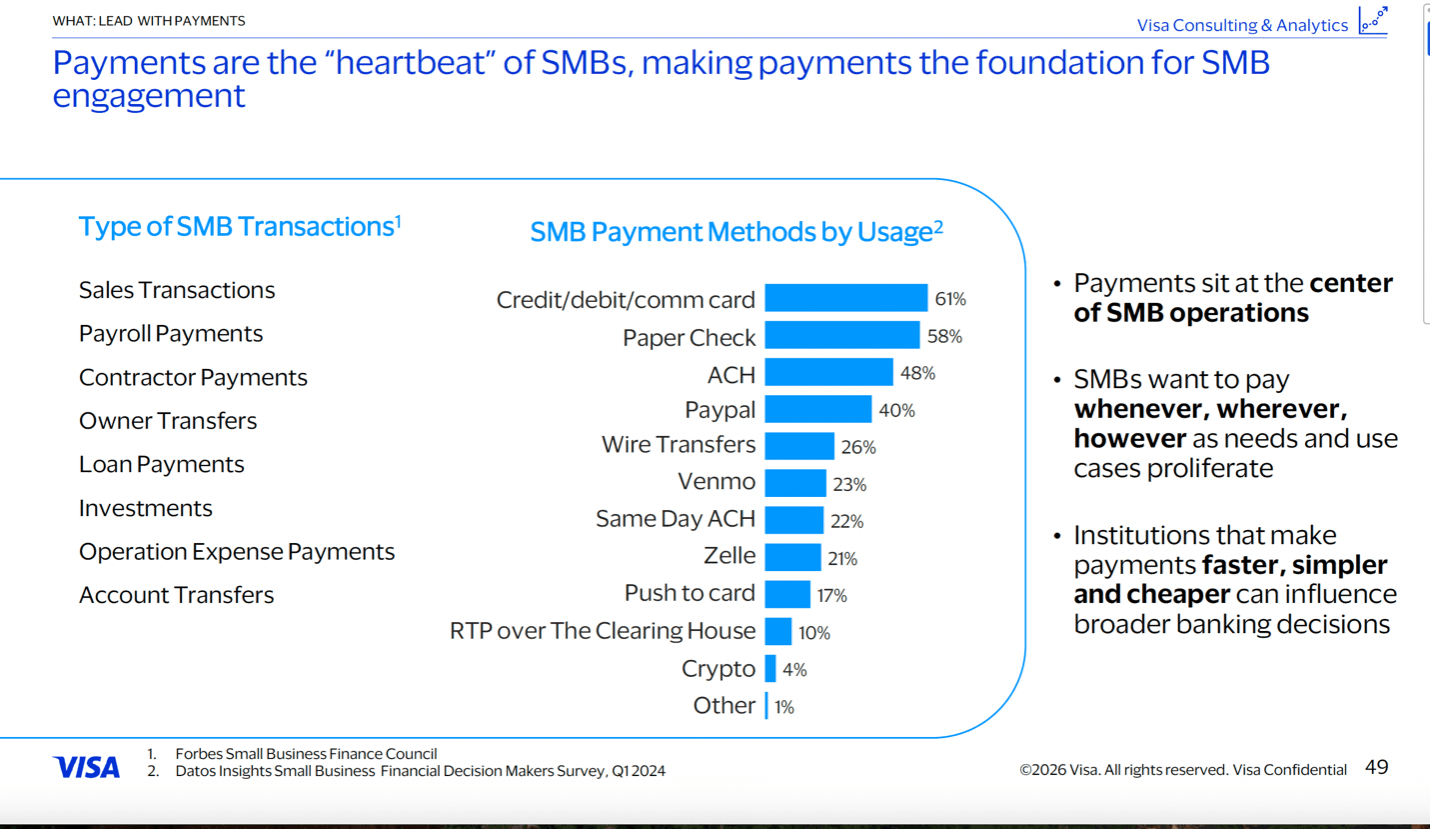
Start by taking a hard look at your current business credit card offerings. Unattractive rewards and high processing fees are the most common pain points SMBs experience with their PFI. A solid rewards program is a way to attract growing businesses looking to switch from a personal card to a business credit card. However, funding robust rewards programs can be costly, so it’s wise to consider other methods of acquiring new SMB relationships.
- Lean into your core strengths: Micro and small businesses are attracted to several areas where community banks excel, including transparent fees, competitive rates, credit access, local knowledge and personalized service and support. Community banks should double down on these attributes and focus on communicating their value proposition to this market.
- Support SMBs’ credit needs: A recent study found that one in five SMBs that switched their banking relationship were denied a loan. Ready access to credit to meet daily cash requirements and operational expansion needs is critical for firms in a growth phase. Whereas big banks focus on speed and scale, community banks deliver service and solutions. Because your bank thinks locally and is embedded in your community, you’re well-positioned to look beyond the credit score and make relationship-based underwriting decisions.
- Engage early and often to increase profitability: As businesses grow and scale, their priorities shift from basic needs, like quality service, to more sophisticated requirements, like access to robust data and financial reporting. Make sure to actively engage with your micro- and small-business customers as they emerge from the startup phase and begin their growth trajectory. This is the ideal time to introduce a conversation around their evolving needs and how your community bank can best support them.
The best way to deepen these relationships and attract more of them is to simply double down on what you already do best: leverage local knowledge and provide outstanding service to meet SMBs’ needs.
Download our latest Banking in Focus research to learn how your bank can capture a greater share of the lucrative SMB market.
About Primax
Primax provides banks with payment processing services and an expansive array of value-added technology and solutions. Primax’s customizable solutions, including risk management, mobile and online card management, data and analytics, loyalty programs, marketing, strategic consulting, delinquency management and contact center services, help banks profitably grow their portfolios and deliver an unparalleled experience to their accountholders.