
With AI as a catalyst, fraud activity has grown substantially in recent years, with 60% of financial institutions reporting an increase over the past 12 months. Overall, Federal Trade Commission data showed that consumers reported losing more than $12.5 billion to fraud in 2024, a 25% increase over the previous year.
In this article, we discuss the current fraud landscape, including emerging threats from AI. We also share how your bank can benefit from tapping into a robust fraud-prevention partnership ecosystem and deep data insights to help mitigate potential fraud losses.
AI is Supercharging Fraud
At Primax, we continuously monitor emerging fraud threats and share our findings with our bank clients and partners. Here are the most impactful trends we’re watching now:
Card-not-present (CNP) fraud has been a concern for years, but it’s a problem that isn’t going away anytime soon.
CNP fraud occurs when a criminal uses stolen credit or debit card credentials to make unauthorized purchases online or over the phone. Because the physical card is not present during the transaction, this type of fraud is difficult to detect and prevent. Today, CNP makes up roughly 80% of total card fraud. Effective mitigation strategies include merchant adoption of 3DS authentication (along with issuer implementation).
We’ve also been eyeing a surge in consumer-engaged fraud, which comes in a few flavors. This category includes social engineering scams — which have evolved in recent years to incorporate the use of deepfakes and other AI-enabled techniques — and misuse fraud (formerly known as first-party fraud). In fact, 2024 was the first year that first-party fraud surpassed scams as the leading form of fraud worldwide.
Social engineering accounted for $32 billion in losses in 2025, and 98% of cyberattacks had a social engineering element. Impersonation scams alone rose by 1,400% between 2024 and 2025.
Misuse fraud, in which the consumer is aware of or actively participating in the scam, accounted for $100 billion in losses in 2025. In this type of fraud, the first party acts fraudulently without outside influence. The consumer’s involvement in such scams is often deliberate, such as when they purchase a product or service with no intention of ever paying for it. They may dispute a legitimate transaction or attempt to return an item to a merchant after it’s already been used. The industry is seeing a significant increase in misuse fraud among Gen Z consumers, a trend that may be related to the erosion of loyalty among this generation.
The use of synthetic IDs is another concerning trend that specifically targets new account opening and credit application scenarios. This category accounted for $38 billion in losses last year, and 95% of such scams go undetected during new account opening.
Account takeover (ATO) continues to be a problem for banks and other financial organizations, and in fact grew 250% in 2025. AI and deepfakes are making these types of attacks more sophisticated and effective.
Lastly, AI-generated fraud, 85% of which involved generative AI like ChatGPT, resulted in $45 billion in losses last year. This category often utilizes deepfakes and other sophisticated techniques. Consumers should be aware that the common practice of uploading selfies online makes it all too easy for criminals to create convincing deepfakes.
Embrace a Data-Driven Fraud Prevention Strategy
To effectively address the growing threat of payments and account fraud, financial institutions must fight fire with fire. This means employing a multi-pronged approach, starting with robust authentication practices.
Traditionally, authentication best practices have centered around multi-factor authentication, which employs a combination of something the customer has, something they know and something they are.
For example, the knowledge factor can be authenticated by asking the customer a series of in-wallet or out-of-wallet questions. Biometrics can be used to confirm that someone is who they say they are. And a one-time password (OTP) or token authenticates the individual using something they have in hand (such as their mobile device).
As effective as these established authentication methods have been, fraudsters are growing increasingly sophisticated and are deploying new (often AI-enabled) techniques to infiltrate these “moats” around the castle. Through phishing attacks, AI deepfakes and account takeovers, criminals can breach even the staunchest defenses.
That’s why data is playing an increasingly important role in modern fraud prevention. It is the fourth and critical leg of a comprehensive authentication protection strategy.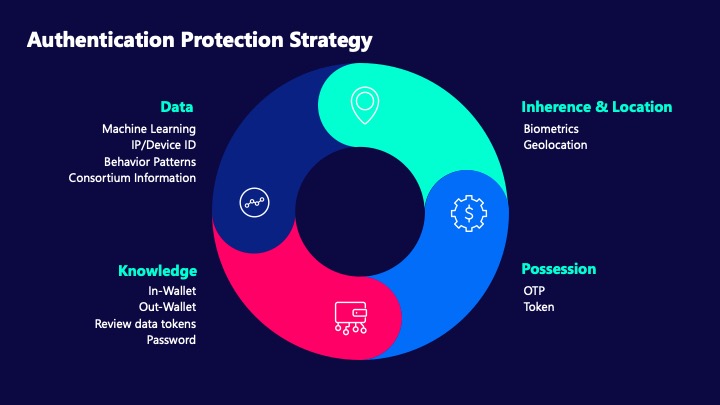
This four-pronged approach leverages new technology across the three traditional areas of authentication, then layers in detailed data captured across a variety of channels. This method creates a complete picture of your customer’s legitimate behavior and activity, helping you understand the full end-to-end consumer story.
The data channels sourced include device ID and IP address (to confirm geographic location and assess whether it aligns with known areas of fraud activity), consumer behavior and transactional patterns, and outside information shared by other financial institutions and merchants within the fraud prevention community.
When such cross-channel data is analyzed holistically, using machine learning and other advanced techniques, it enables fraud mitigation professionals to identify patterns of behavior and visualize anomalies that they would not otherwise see. Taken together, this information helps identify suspected fraud even when the customer is indicating otherwise.
An Ounce of Prevention
The other key to preventing fraud lies in developing a robust education program for your customers and staff. Yet, it’s often challenging to stay current with the latest fraud techniques and threats, let alone to communicate them out in a timely and easily digestible format.
At Primax, we take our role as our banking clients’ fraud prevention partner very seriously. That’s why we offer a comprehensive library of fraud education and awareness resources to help your customers and staff stay informed and up to date.
We provide our clients with access to a central hub of resources and insights through our Risk Community website. This site is continuously refreshed with the latest risks and trends we’re watching. It includes current industry news, a near-real-time view of confirmed fraud (including affected merchant names and IDs) and monthly consortium statistics to help you set your fraud performance benchmarks.
Primax also regularly publishes deeply researched educational materials such as the Consumer-Engaged Fraud Classification Guide. These resources are designed to provide banks with best practice guidance for mitigating known and emerging threats.
For consumers, it’s important to keep the messaging simple and easily digestible. We’ve created a series of educational videos designed to quickly and concisely inform the public about emerging fraud threats and new scams.
Balancing Fraud Management and the Customer Experience
In the face of accelerating threats, navigating that delicate dance between fraud management and customer experience is crucial to a financial institution’s success. Primax’s integrated approach links all data from every transaction, interaction and event to predict and prevent customer fraud while expertly recovering any losses for more fraud-fighting power. To learn more about Primax’s fraud prevention resources and our comprehensive partner ecosystem, visit: primax.us.