

“This makes me so uncomfortable …”
Here’s a puzzle that every bank leader faces: How do we achieve and innovate in new ways that cross organizational boundaries — without facing massive resistance?
The need to change is everywhere. To succeed in today’s market, community banks need to expand their digital services, improve card program profits, enhance consumer experiences and grow their customer base, all of which require operational changes. Achieving meaningful growth starts with a willingness to rethink how we work.
One of the most impactful shifts leaders can make is embracing true transparency — creating space for candid conversations, shared accountability and continuous improvement.
However, when you talk to leaders at every level — in every industry — instead of getting real, I hear: “well, I just don’t feel comfortable saying that,” or “I think that telling them something critical might make them shut down, so I say ‘yes’ in the moment, and then meet privately with others to create a workaround.”
 When I work with financial institution leaders and HR professionals and ask them to list problem areas, “having difficult conversations” ends up on that top five list every time. That’s because many of us are conflict-averse. We get uncomfortable when we must confront someone or deliver bad news, so we look for ways to frame it, delay it or avoid it altogether. We’ll go to great lengths to avoid telling someone something they don’t want to hear; in fact, an entire episode of the Emmy-nominated series “The Studio” was based on that very premise! (Is Ron Howard really that nice?)
The Five Conflict Modes
Conflict is a natural part of human interaction, and each of us has a preferred way to manage it. We may not like it and find all kinds of ways to avoid it, but ultimately, when forced, we will all eventually try to come up with a workable solution to address an uncomfortable issue.
There are several well-established ways to manage conflict. One of the most widely used frameworks is the Thomas-Kilmann Conflict Mode Instrument (TKI), which identifies five conflict management modes based on assertiveness and collaboration. NOTE: While each of us has a preferred method for managing conflict, we have all developed some skill in each of these methods. Also, circumstances can drive that decision for you — If you’re in a burning building, you likely won’t try to pull a team together to discuss.
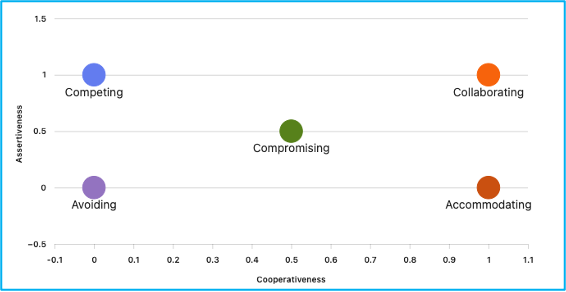
Competing (High assertiveness, low cooperativeness)
- Approach: Pursuing one’s own concerns at the expense of others.
- Common in: Crisis situations, when quick decisions are needed.
Collaborating (High assertiveness, high cooperativeness)
- Approach: Working together to find a win-win solution.
- Common in: Complex issues requiring integration of multiple perspectives.
Compromising (Moderate assertiveness and cooperativeness)
- Approach: Finding a middle ground.
- Common in: Situations where both parties give up something to reach agreement.
Avoiding (Low assertiveness, low cooperativeness)
- Approach: Not addressing the conflict.
- Common in: Trivial issues or when the cost of confrontation outweighs the benefit.
Accommodating (Low assertiveness, high cooperativeness)
- Approach: Yielding to others’ concerns.
- Common in: Preserving relationships or when the issue matters more to the other party.
The most commonly used modes vary by culture, personality and organizational context, but generally:
- Avoiding and Compromising are frequently used in workplace settings, especially when people want to maintain harmony or avoid escalation.
- Collaborating is ideal but less common due to the time and effort required.
- Competing is more common in high-stakes or hierarchical environments.
- Accommodating is often seen in service roles or when power dynamics are uneven.
Lead the Way: No More “Mr. Nice Guy” — “Mr. Kind Guy” Instead
When we face conflict in a professional setting, we often don’t want to risk jeopardizing the relationship (“this project will come and go, but I’m still going to have to work with them”). For those of us who cringe at conflict, how do we move from being nice (making the other person feel okay) to being kind (telling them what they need to hear and achieving the objective)? How do we meet the needs of all parties while preserving the relationship?
Each of us has a preferred style, but often, different situations require different approaches. Leaders can play a crucial role in fostering positive conflict resolution strategies; here’s how you can encourage constructive resolution among your teams:
- Promote Awareness of Conflict Styles. You can start by introducing the TKI model to your team. It will help them recognize their own default conflict styles, understand others’ approaches, and learn how to flex depending on the circumstances. Even if you have a go-to style, remain aware that other styles may be appropriate for other types of conflicts.
- Encourage Collaborative Problem-Solving. Create environments where open dialogue and joint problem-solving are valued. This will lead to innovative, win-win solutions and better team cohesion. To help balance differences in status and level, it’s key to create a psychologically safe environment, one where it’s safe to take interpersonal risks, to speak up with ideas, questions, concerns or mistakes without fear of social punishment or humiliation.
- Normalize Healthy Disagreement. Encourage assertiveness when stakes are high or when decisions need clarity. This “competitive” approach helps drive decisive action while still respecting differing viewpoints.
- Model and Reward Compromise. Recognize when team members find middle ground and celebrate balanced outcomes to build trust and fairness in decision-making.
- Create Safe Spaces for Reflection. Allow time-outs or cooling-off periods when emotions run high to prevent escalation and support thoughtful resolution at a later time.
- Support Empathy and Flexibility. Take an “accommodating” approach to build goodwill and emotional intelligence across teams. Encourage listening and yielding when appropriate, especially when seeking to reinforce relationships.
Perhaps most importantly, lead by example. Demonstrate a balanced use of conflict modes depending on context and use coaching conversations to help team members reflect on their conflict responses.
Constructive conflict resolution begins at the top – so if growth is in your bank’s forecast, prepare your teams with healthy strategies for change.
Tom Olney: As Vice President of Organizational Development, Tom Olney oversees Primax’s employee and leadership development programs. He also partners with Advisors Plus to offer organizational effectiveness workshops, succession planning, Organizational Change Management (OCM) consulting and support, coaching and customized team development workshops to financial institutions. Tom is passionate about helping leaders at all levels achieve better results through people; and he loves building coalitions to complete difficult projects, delighting the client, deepening relationships and leveraging emerging technology for creative solutions. He is a graduate of the University of Central Florida, with a Masters of Science, Industrial Organizational Psychology, and has more than four decades’ experience in Organizational Development, Project Management, OCM and Knowledge Management.